Fellows Group Project: Making Bio-Imagery Pop and Groove
Explorations in conservation engagement through immersive visual and sonic exhibits
“We are currently experiencing an unprecedented era of a warming climate and urbanization which pose a serious threat to biodiversity worldwide. Moreover, these global change drivers are set to impact communities unequally which underscores the need for broadening participation in conservation so that a diversity of voices can be represented in the decision-making process.
As such, stemming the loss of biodiversity necessitates both cutting edge science, but also societal involvement. This includes including local communities into the process of interacting with the natural world in an increasingly digital world and educational system, but also immersing them into the infinite beauty of nature. Many of us entered careers as conservationists out of a passion and emotion to understand the natural world as opposed to sole scientific curiosity. Thus bringing people closer together to the living things that crawl, swim and walk – from remote volcanic islands, to tropical rainforests, up to the tree in our front yard— is imperative to promote stewardship of our environments as well as our own physical and mental well-being.”
Through a collaborative project supported by both Group Project Funds and Broadening Participation Funds, Diego Ellis Soto (2024 Fellow) and Vaughn Shirey (2023 Fellow) brought this vision to life in an interdisciplinary exhibition at the Florida Museum of Natural History. Their work fused ecology, conservation research, data visualization, alternative process photography, and music into an immersive experience designed to engage diverse public audiences in new ways.
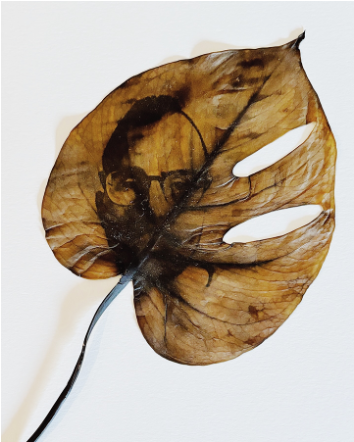
The exhibition centered on interactive installations featuring butterfly photography created through sustainable chlorophyll and anthotype processes, paired with ecosystem soundscapes and site-specific musical compositions. Visual depictions of threatened Lepidopteran species and their host plants were complemented by ecological sound data—capturing bird biodiversity and sound pollution metrics—translated into layered audio pieces blending natural sound with analog electronica. The result was a multisensory environment where science, art, and music converged.
In addition to the exhibition itself, the project included a targeted outreach event for students and museum visitors. Participants explored the intersections of art, music, and conservation, experimented with nature-based artistic techniques, and created their own nature-inspired electronic compositions. Attendees also received low-cost microscopes to continue exploring insects and plants in their own communities, extending the experience beyond the museum walls. By combining scientific rigor with creative expression, the project demonstrated how conservation engagement can be both intellectually rigorous and emotionally resonant—broadening participation while deepening connection to the natural world.