Proposal Guidelines
2027 David H. Smith Conservation Research Fellowship (Smith Fellowship)
Bridging the Gap Between Research and Application
This version was updated June 18, 2026.
Below are the application guidelines for the 2027-2028 Fellowships. Please note that the guidelines change and evolve year to year, and are updated annually when the application cycle opens (around June), so ensure you are using the most recent version when assembling your application. Please ensure you carefully review the eligibility criteria before beginning your application.
Important Dates & Deadlines
For 2027 Fellowships:
Application Deadline: All application materials, including letters from mentors and references, must be received by the Smith Fellows program via the online submission platform by 11pm ET on Wednesday, September 30, 2026. The review process begins immediately after this date. There are no extensions to this deadline and incomplete applications at this deadline will not be included in the review process.
Interview Phases: Semi-finalist and finalist interviews will be conducted in January and February 2027.
Status Notifications: All candidates will be notified of the status of their application by February 28, 2027 at the latest.
Fellowship Start: Funds are available for Fellows to start anytime between June 1 and September 30, 2027.
Fellowship Overview
The David H. Smith Conservation Research Fellowship Program aims to cultivate the next generation of global leaders and innovators who are inspired and empowered to turn conservation science into effective real-world solutions. Founded in 1998, funded by the Cedar Tree Foundation (CTF), and administered by its administrative partner the Society for Conservation Biology (SCB), the Smith Fellowship offers a prestigious full-time, two-year postdoctoral opportunity for early-career scientists to pursue innovative, solutions-oriented research addressing pressing conservation challenges in the United States and its five permanently-inhabited territories (Puerto Rico, the US Virgin Islands, Guam, the Northern Mariana Islands and American Samoa). Fellows receive two years of salary and research support, while participating in a unique program of structured mentorship, training retreats, and community building with a vibrant network of Smith Fellows alumni spanning academic, governmental, and nonprofit sectors.
Each year, Smith Fellows are selected as much for their personal statements and leadership potential as for the research they propose: we fund the person as well as the project. The program is grounded in the belief that science can more effectively inform conservation outcomes when integrated with practical, on-the-ground needs and real-world partnerships. In addition to two years of salary and research support, each Fellow receives intensive leadership and professional development training, as well as membership in a close-knit, cohort-based community of Fellows and alumni.
The core scientific focus of the Smith Fellowship Program is on innovative, applied conservation research that directly informs and impacts real-world conservation outcomes through practical, on-the-ground partnerships. Fellows are expected to design and lead projects that address urgent conservation challenges, clearly articulating how the research will be actioned — that is, applied through collaboration with conservation practitioners, policymakers, or communities. A defining feature of a Smith Fellowship project is the requirement for each Fellow to work closely with a team of mentors - at least one academic and one practitioner mentor - who support the Fellow's scientific and professional development and ensure the research is meaningfully connected to conservation practice. Projects should go beyond a continuation of prior doctoral work by incorporating novel, bold, or "risky" elements that push the frontiers of conservation science. The program values clear pathways for action, transdisciplinary integration, problem-solving relevance, and tangible contributions to conservation management and policy within the U.S. and its territories. Successful proposals make a plausible case for the transformative potential of their work: a credible account of how conservation practice, policy, or management could change if the project succeeds, and whether the underlying findings, methods, partnerships, or tools could be scaled or adapted to influence future research, policy, or practice over the long term. This transformative potential is distinct from methodological innovation alone — a project need not be the most novel or technically ambitious proposal to qualify, provided it addresses a high-priority conservation challenge and makes a convincing case for meaningful, lasting impact.
The core programmatic focus of the Smith Fellowship Program is to provide growth and development opportunities for Fellows — through structured mentorship, intensive leadership and professional development training, and a close, collaborative community of peers and alumni. Fellows participate in three to four week-long retreats annually, focused on collaboration and skillbuilding in areas such as science communication, policy engagement, leadership development, and site-based conservation work. Community is built through both structured programming and unstructured time together: Fellows gain a network of peers to navigate this transitional stage of their careers, and opportunities to collaborate with one another on creative projects. These program elements are core to what it means to be a Smith Fellow, and therefore require a substantial time commitment across the two years; applicants should design their research timelines with the full scope of Fellowship activities in mind.
Smith Fellows’ research and activities have long served on the cutting edge of conservation research, producing leaders in applied conservation science. Through the program’s unique combination of research, mentorship, professional development, and community building, the Smith Fellowship advances both individual careers and the broader field of conservation science, building a diverse and dynamic network of leaders driving positive change for nature and people.
Mission & Values
The mission of the David H. Smith Conservation Research Fellowship is to create opportunities for leading conservation scientists to engage in innovative/novel applied research and strengthen their skills through two years of applied post-doctoral research, supplemented by professional development programs, peer networking, and field learning experiences, so that they may:
Build productive partnerships with conservation practitioners;
Contribute to solutions that address critical conservation problems through research and practice; and
Advance engagement with and understanding of conservation issues through communication, outreach, and diverse partnerships.
Smith Fellows Values Statement
Below is a living articulation of our shared community values. Created by the Smith Fellows Program Advisory Board, Staff and with input from the Fellows community, it is intended to grow and adapt over time as an evolving expression of our collective principles. Learn more and read guiding principles for our community here: https://www.smithfellows.org/values-conduct
The Smith Fellows Program and community value respect and dignity for all. Likewise, as an entity promoting approaches based on and informed by evidence, we recognize and welcome diverse systems of evidence, including scientific, local, traditional, Indigenous, and community knowledge, as well as multiple ways of knowing. The Smith Fellows Program recognizes that the advancement and excellence of conservation research and practice is intertwined with and relies on a commitment to greater access and inclusion of people of many views, vantage points, identities, lived experiences, and geographies who actively participate in conservation with equal opportunity, access, and sense of belonging. We strive to embrace these values in all aspects of the Program’s operations.
Eligibility
Career Stage: To be eligible, applicants must have completed their doctorate within the three years preceding their award date, or by the time the award is made in 2027. For the 2027-2028 Fellowship, applicants must have completed their doctorate after April 1, 2024 and before August 31, 2027 to be eligible.
Applicants who have not yet completed their doctorate must clearly indicate on the application the date the degree is expected, and should expect to be asked for confirmation from their advisor(s) that they are on track to complete their doctorate within the required timeline during the review period. The Fellowship start cannot be deferred or delayed, so we strongly recommend to aim for completing your PhD in July to allow for unforeseen delays and time to transition between these two significant life stages.
Career interruptions (including parental or family leave, medical leave, or other qualifying circumstances) may be excluded from the three-year eligibility window. Applicants with exceptional circumstances are encouraged to contact program staff for clarification or to confirm eligibility before formally applying.
Citizenship: Applicants do not need to be U.S. citizens. International applicants must secure a visa through their host institution; the Smith Fellows Program does not provide visa sponsorship.
Geographic Research Focus: Research must be of primary relevance to conservation management or policy in the U.S. or its five permanently-inhabited territories (Puerto Rico, U.S. Virgin Islands, Guam, Northern Mariana Islands, and American Samoa). The majority of the research must take place on site within these locations and include relevant local partnerships.
Institutional Affiliation: The Fellowship must be administered by a U.S.-based institution (academic or conservation organization). The host institution is responsible for administering salary and benefits, providing necessary office/lab space and other resources, and confirming compliance with program policies for equipment and indirect costs.
Please note we accept only one proposal per applicant each cycle. If you submit multiple proposals, you will be asked to choose one and the other(s) will be excluded from the review process.
Award Terms
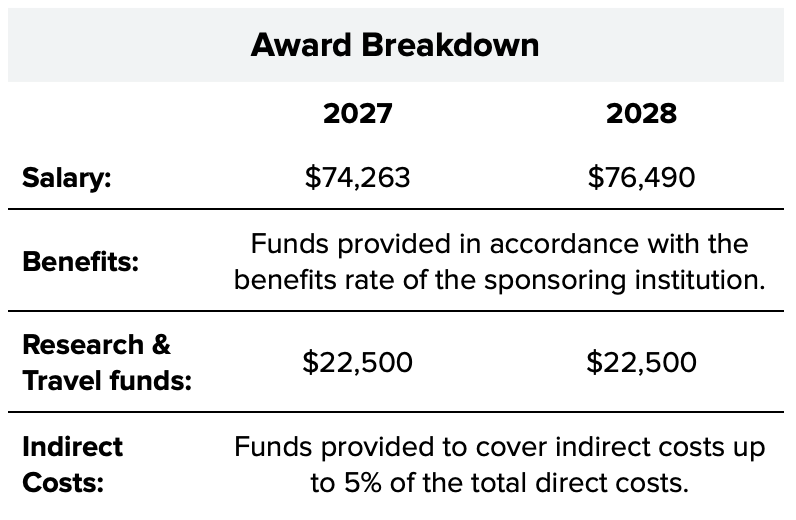
Each Fellow will receive an annual salary of $74,263 in 2027 and $76,490 in 2028, plus benefits, with the post-doctoral position expected to run for two consecutive years. In addition to the stipend, each Fellow receives a travel and research budget of $45,000 over the 2-year fellowship period ($22,500 per year).
Fellows may be administratively based at either the sponsoring academic institution or a conservation organization and are typically based at the location of either the academic or practitioner mentor. We encourage applicants to explore all options to determine which would be more suitable to the proposed research and beneficial to their continued development as a scientist. Applicants may also wish to consider the benefits packages offered at each of their potential host institutions.
The host institution or organization is responsible for administering the award and will be the official employer of the Fellow (administering salary and benefits, and visa sponsorship if needed). The program will provide up to 5% of the total direct costs as overhead reimbursement to the host organization.
The award funds are disbursed in one year increments, and second-year renewal of the Fellowship is contingent upon satisfactory progress (including but not limited to participation in program-sponsored retreats) as well as timely completion of first-year activity and financial reports.
Separate from individual awards, there are supplemental funding opportunities available (accessed directly through the program) to support special projects like collaborations between Fellows and alumni, broadening participation initiatives, and regional Fellow meet ups.
Programmatic Experiences & Retreats
Fellows will spend three to four weeks per year during their fellowship attending Program-sponsored professional development retreats. These retreats are a core aspect of the Fellowship experience, and participation is required. Smith retreats are developed in collaboration with the Fellows in order to provide opportunities to cultivate skills not typically covered during their academic education including: leadership, communications, professional and funder networking, policy-making, and research applications. Fellows have an opportunity to play a significant role in hosting, leading, and designing retreats, which is an intentional professional development experience in and of itself. Retreats and other required Fellowship activities occupy substantial time across the two years, and applicants are expected to plan their project timeline with this commitment built in from the start. Retreat dates are chosen collaboratively with the participating cohorts, and are generally scheduled for January/February, May, and October of each year. Selected Fellows can expect to attend their first retreat in May (often before their Fellowship officially begins). You can read more about the programmatic aspects of the Fellowship here, and learn about past retreats on our blog.
Mentor Team
Each applicant proposes a team of at least two mentors (we welcome and encourage more) to work closely with them during their Fellowship, including:
Provide an institutional home (academic or practitioner-based).
Help design and guide the research, connecting it (and the Fellow) to real-world conservation applications.
Support the Fellow’s leadership growth, skills development, and integration into professional networks.
Meet regularly with the Fellow, participate in program site visits, and co-develop a mentorship plan.
Help fill gaps in Fellow’s expertise areas (for example, social science).
At least one mentor must have a primary focus on conservation practice, and will help to connect the Fellow’s research to practical applications and provide insight into the management and policy implications of the work. The mentor team is integral to the Fellow’s and project success, and mentors are expected to be an active part of the proposed research plan and to meet with Fellows regularly to help shape and guide the work.
Fellows may choose to assemble a team of more than two mentors. This may be beneficial if there are particular skills or perspectives critical to the project that represent a new approach for the Fellow, and a mentor with that expertise would help guide the project. Only the primary academic and practitioner mentors will be required to submit a letter of support for the application. Co-mentors are permitted.
Application Materials
**Please note that the portal is not yet open for 2027 Fellowships applications; we plan to open it by the end of June. You may begin preparing your application according to these guidelines.
All materials must be submitted electronically on our online submission platform: apply.smithfellows.org. All files should be uploaded in PDF or MS Word format. Please contact Program staff at smithinfo@conbio.org if you have any challenges accessing or submitting items to the application portal.
Before beginning your application, please thoroughly review these Proposal Guidelines in their entirety - including the evaluation and selection criteria - to ensure you clearly address and incorporate the critical components of a successful Smith Fellowship proposal.
For all uploaded materials, please follow the specified page limits and formatting guidelines:
Font size must be at least 11 point
Margins must be at least 1 inch/2.5 cm
Line spacing must be at least 1.5
In addition to a completed application form that asks for details about both the applicant and the project, the required application materials are as follows:
Cover letter | No page limit; uploaded as a standalone document. The David H. Smith Conservation Research Fellowship Program aims to cultivate the next generation of global leaders and innovators who are inspired and empowered to turn conservation science into effective real-world solutions. Why are you interested in becoming a Fellow and how will the Fellowship help you achieve your career goals? Applicants should not use cover letters to restate or extend material presented in the proposal, personal statement(s), and vita.
Proposal Package | Section-specific page limits outlined below, all sections uploaded together as a standalone Proposal document. The proposal package must include all components listed below in sequence, and follow all page limits and formatting guidelines in order to be considered eligible for review.
a) Title Page | One page limit. Include applicant's name, contact information, project title and mentor/reference descriptions:
i. Mentor team: please list all mentors along with a brief (one sentence) description of roles/anticipated nature of support, as well as institutional affiliations
ii. Reference names: please list along with institutional affiliations.
b) Research Plan | 9 page limit. Please provide citations and other evidence for the innovative nature of your proposed work in your proposal.
i. Abstract
ii. Background & Context:
Problem, scientific context, and conservation relevance: Describe the conservation challenge and the scientific context your work addresses. What is currently understood, what remains unresolved, and what specific gap does your project target? Discuss the relevance of the proposed research to conservation science and practice: what conservation problem does this work address, and why does it matter?
Rationale and Innovation: Why is this work needed now? How does it build on — and move beyond — existing research and your own prior work, including your doctoral research? Identify what is novel, innovative, bold, or risky about the proposed approach.
Transformative Potential: What is transformative about the work — what would meaningfully be different in conservation practice, policy, or management if the project succeeds? Beyond the immediate outcomes, consider whether the findings, methods, partnerships, or tools could be scaled or adapted to influence conservation research, policy, or practice over the longer term. (Transformative potential is distinct from novelty alone: a project need not be the most technically novel to qualify, provided it addresses a high-priority problem and makes a convincing case for meaningful, lasting impact.)
Pathway to Application: Describe your role and the proposed mechanism for conservation application — how the work will help solve the problem(s) identified above, and the approach by which it will be "actioned." Be specific about with whom and how: which conservation policymakers and/or practitioners (e.g., federal, state, or local agencies, legislators, NGOs, community groups) will use or benefit from this work? Reference any existing or future connections, partnerships, or conversations that support the feasibility of this pathway.
iii. Origin story: Share the origin story of your project and how your mentor team came together. If this is part of a larger existing collaboration, how does your proposed work fit in? Describe your leadership role within this proposed work.
iv. Statement of Objectives
v. Approaches & Methods
vi. Anticipated Results
c) Literature Cited | No page limit.
d) Budget & Timeline Narrative | No page limit. Please provide a 2 year projected budget/timeline with a brief narrative explanation around planned use of the research and travel funds ($22,500 per year, awarded at the beginning of year one and year two, for a total of $45,000, you can rollover unspent funds from year one into year two). We recognize that a number of factors may impact the proposed budget, and we can be flexible in this regard with accepted proposals. The budget should include:
i. research travel and accommodation costs
ii. research supplies/equipment
iii. contract or other outsourced services (eg. sequencing)
iv. other costs (explain)
3. Applicant’s Curriculum Vitae | No page limit; uploaded as a standalone document.
4. Personal Statements | Four questions with a maximum of 250 words each; submitted as plain text individual question responses within the application form. Please address the following questions:
a) Tell us a story about a leadership or community-building experience that was challenging for you, and how it helped you grow and shape your vision of leadership for yourself.
b) What do you think is required of conservation scientists to successfully bridge the gap between research and practice? Which of your qualities will help position you as a leader who can effectively bridge that gap?
c) How have your life experiences and background informed your approach to broadening participation, building inclusive community, and fostering a diversity of perspectives in conservation?
d) The Smith Fellowship is a cohort-based program. If you are selected as a Fellow, how do you hope to both benefit from and contribute to your cohort and the wider Smith Fellows community?
5. Letters & Mentor CVs. Once a letter writer is listed in the application portal, they receive an emailed link to upload their letter. The applicant can see in the portal whether each letter has been uploaded, but cannot finalize and submit the application until all letters are present. Ensuring letters are submitted by the deadline is the applicant's responsibility; letters should be requested early. A maximum of four letters (two reference, two mentor) may be uploaded, to limit the burden on applicants and reviewers. An applicant may have more than two mentors, but support letters are not required from more than two. If an applicant would like additional mentors represented, mentors may write a joint letter, or a mentor may supply one of the two reference letters — provided no more than four letters total are associated with the application.
a) Reference Letters of Support (2) | No page limits.
Two letters addressing the merits of the candidate and the proposal, written by individuals familiar with the applicant's skills, experience, and research. Applicants may not upload reference letters directly; they must be uploaded by the letter writers themselves. Reference letters should speak to:
i. The applicant's qualifications, and why they suit the Smith Fellowship specifically as opposed to another opportunity
ii. Any unique ability the applicant has to contribute significantly to conservation science and practice
iii. The novelty of the approach and the quality of the applicant’s science
iv. The potential of the applicant and their work to impact conservation practice
b) Mentor Letters of Commitment (2) | No page limits.
Letters from the two primary mentors (one academic, one practitioner). Mentor letters may be uploaded by either the applicant or the mentor. Each letter should:
i. Commit to supporting the applicant — including research design, connecting the applicant and their research to practical applications, supporting their professional development as a conservation scientist, and helping build research skills, collaborations, and networks — and articulate the nature of that support
ii. Describe the outcomes the mentor hopes to see from the work: for themselves, for the applicant, and for the conservation problem
iii. Share the story of how this potential collaboration came to be
iv. Commit to regular meetings, participation in program site visits, and developing a mentor plan with the applicant if accepted
v. Fellows may be administratively and/or physically based ("hosted") at either mentor's institution. The host mentor's letter should additionally:
Verify the availability of laboratory/office space and other relevant institutional resources
Describe how the applicant's research relates to the host institution's ongoing work
c) Academic and Practitioner Mentors' Abbreviated CVs | Limit 2 pages each.
A 2-page CV for each mentor (similar to the format required by NSF).
Evaluation Criteria & Selection Process
Smith Fellows are selected based on both the strength of their proposed research and their potential as future conservation leaders. We are not just funding projects - we’re investing in people. We are looking for bold, innovative thinkers who can translate science into real-world impact, and who are excited to grow within a supportive, peer-based professional community.
Each application is evaluated in four areas:
Research Quality: Competitive proposals clearly articulate well-defined conservation questions, sound hypotheses, and feasible methods. Projects should be achievable within the two-year fellowship period and demonstrate originality, innovation, and willingness to take meaningful risks. Strong mentorship support and alignment with project goals are essential components of successful proposals.
Conservation Impact: Strong proposals make a clear case for how the research will inform conservation practice or policy. We look for concrete plans to engage with practitioners, policy-makers, or communities, and for work that goes beyond filling knowledge gaps to offer real solutions.
Innovation & Track Record: We look for applicants who have shown creativity, excellence, and collaborative strength in their past work. Letters of recommendation, personal narratives, and prior research all help us understand your potential to lead and contribute meaningfully to the field.
Leadership Potential & Program Fit: We are building a diverse, dynamic network of conservation leaders. In addition to communication and leadership potential, we consider how applicants’ lived experiences, values, and goals will enrich the fellowship community. We look for individuals who are excited to engage with peers, contribute to cohort learning, and grow as part of a shared journey.
In making final decisions, we also consider the balance of topics across the fellowship cohort and broader network (portfolio balance). Our goal is to build a research portfolio that spans issues, geographies, methods, and perspectives, so we typically avoid selecting multiple projects that closely overlap in scope or focus within the same (or recent) cohorts.
Please note: while it is acceptable for a project to involve a continuation of the applicant’s previous work, if new or risky elements aren't made clear in the proposal or it doesn't seem like a big change or challenge for the candidate, the application might not score as highly.
The Smith Fellowship selection process typically includes four stages:
Written Reviews (October - November): Each proposal is reviewed and scored by at least three conservation professionals. These reviews assess research quality, conservation impact, and innovation, as well as candidate leadership and experience.
Semi-Finalist Panel (November - January): Approximately 25% of applicants move forward for a second round of reviews and discussion by a live review panel, which expands focus to evaluate the transformative nature of the project and pathways to application, as well as the candidate’s leadership potential, experience, suitability of mentor team, and program fit.
Short Interviews (January): Semi-finalists participate in brief virtual interviews with Smith staff and community members.
Finalist Interviews (January - February): A small group of finalists is invited to participate in more in-depth interviews with a dedicated review panel. This final stage helps determine which five candidates will be offered Fellowship positions.
Throughout the process, reviewers represent a range of disciplinary and professional backgrounds within the broader field of conservation. We strive to match reviewers with proposals that overlap with their expertise wherever possible, however, it is likely that not every reviewer on a given application will be an expert on the proposed methods or topic. We encourage applicants to write clearly, avoid jargon, and highlight how both their science and personal experience can contribute to conservation impact and community leadership.
-
Applicants who are selected as finalists will be asked to submit additional information and make the following arrangements prior to their final interview:
Institutional Commitment Letter of Intent: Finalists will be asked to submit a letter signed by an authorized representative at the host/sponsoring institution confirming/providing the following information:
A commitment to host the applicant should they be awarded a Fellowship
An outline of any relevant resources that will be made available to the applicant while hosted at the institution
The benefits rate for postdoctoral researchers (or other applicable employment category)
Verifying institutional compliance with the following non-negotiable program policies:
Indirect costs: Waiving indirect costs in excess of 5%
Equipment: All equipment purchased with Smith Fellowship funds remains property of the Fellow and will follow the Fellow to their next institution at the conclusion of the fellowship (this is only applicable to equipment that does not exceed the institutional definition of capital expenditures or fixed assets).
Multiple Awards Disclosure: If you are awarded the Fellowship, you will be asked to disclose other sources of funding to the Program staff, and if applicable, provide a short statement on how your proposal will be enhanced or expanded as a result of multiple funding streams. Please note that the Smith Fellows program requires your full-time work on your project, so you cannot accept simultaneous awards, and the Fellowship cannot be delayed or deferred. If you would like to have a conversation with staff about program policies and flexibility regarding multiple awards, please feel free to reach out at any time.
Retreat Participation: Finalists will be made aware of all scheduled retreat dates and locations, including the May retreat. While this retreat will take place before the 2027 Fellowships officially begin, this will be the first official retreat for the incoming cohort so that they may take advantage of all the training opportunities, as well as bond with the outgoing cohort (for whom it will be their last retreat).
AI & Data Privacy Policy
The Smith Fellows Program supports the integrity and originality of conservation science. This policy ensures transparency in how applicants, reviewers, and program staff may use generative AI tools, and how such use may influence evaluation.
Applicant Disclosures
As part of your application, you will be given a chance to briefly disclose whether you used AI tools (e.g. ChatGPT, Grammarly, Claude), and if so, which tools you used, which sections were AI-assisted, approximate percentage of AI-generated text, and the kinds of prompts or instructions you gave the AI tool.
These disclosures will not be penalized and will not be made visible to reviewers. The purpose of this question is to help staff understand at scale more about the changing application landscape with the prevalence of AI tools.
Program Use of AI
Smith Fellows staff may use trusted AI tools to assist with:
Organizing and summarizing reviewer feedback, including providing feedback summaries to applicants
Effectively matching proposals with reviewers across factors like overlapping skills, methods, and expertise
Ensuring consistency and fairness in the review processes
AI will not be used to evaluate proposals, generate proposal scores, or replace human judgment in selection.
Confidentiality, Data & Intellectual Property
All proposal materials, including AI-assisted content, remain the intellectual property of the applicant. No part of your application will be used for AI model training or shared outside the Smith Fellows review process.
Resources for Applicants
We recognize that developing a strong Smith Fellowship application requires a meaningful investment of time and effort. Our goal is to run an application process that itself serves as a professional development exercise: one that sharpens applicants' research thinking, clarifies the conservation relevance and applications of their work, and strengthens their articulation of a research vision, regardless of outcome. In recognition of this investment, the program commits to providing every applicant with:
the support and information needed to submit a competitive application; and
constructive reviewer feedback on their proposed research and its conservation relevance.
Applicants are encouraged to review the full program website before crafting their proposal. The program details page provides an overview of the Fellowship's unique components and the Smith Fellows network, and the News & Updates page offers a closer look at recent retreats, trainings, group projects, and broadening participation initiatives.
Current Smith Fellows and alumni understand that they may be contacted by applicants with questions about their experience with the Fellowship and/or application process. Fellows will reply to such requests as they are able. A directory of past and current Smith Fellows — including projects, searchable by keyword — can be found on the Meet the Fellows page.
Smith Fellows staff attend various professional conferences and welcome the opportunity to connect with prospective applicants at informational sessions or in individual meetings.
Webinars and office hours for applicants will be held throughout the summer and early fall; scheduling information will be posted here as it becomes available. Two recent webinars are linked below as orientation to the application and selection process. Note that process details change year to year — these recordings may contain outdated information, and these guidelines take precedence.
Because the application form, review process, and selection criteria are revised (sometimes extensively) each cycle, applicants are advised not to seek out materials from prior years. The most reliable resources are those issued for the current cycle, including these guidelines. Additionally, proposals repurposed from other opportunities are generally not as competitive as proposals developed specifically for this program, unless they have been extensively reworked to reflect the unique nature and goals of the Smith Fellowship program and funding.
A list of frequently asked questions is available here. Applicants are encouraged to consult this resource before contacting program staff.
Contact our team with any questions at: smithinfo@conbio.org